Three uninterrupted long-horizon executions show the complete task process from initial observation to final completion without editing or temporal cuts.
Meal Delivery · One Take
Steak Cooking · One Take
Chair Pushing · One Take
Abstract
We present RynnBrain 1.1, a family of embodied foundation models spanning 2B, 9B, and 122B-A10B scales. Built on a unified spatio-temporal and physically grounded training framework, RynnBrain 1.1 supports embodied perception, spatial reasoning, localization, grounding, and planning across model scales. Compared with RynnBrain 1.0, RynnBrain 1.1 introduces contact-point prediction for task-relevant interaction locations and in-plane grasp orientations, together with native 3D grounding that enables the 2B and 9B models to perform language-conditioned grounding in metric physical space. We further develop RynnBrain-VLA with a unified cross-embodiment action space and embodiment-specific masking, and evaluate it on a Unitree G1 humanoid, an Astribot-S1 bimanual robot, and a Tianji-Wuji dexterous-hand system. Experiments show that RynnBrain 1.1 achieves strong performance on embodied cognition, spatial reasoning, localization, and 3D-grounding benchmarks. Controlled real-robot evaluations further demonstrate that VLA policies initialized from RynnBrain outperform Qwen-based VLA policies and representative VLA generalists, while joint multi-task and multi-embodiment training improves both average process scores and final task success rates over separately fine-tuned per-task policies.
RynnBrain 1.1 Results
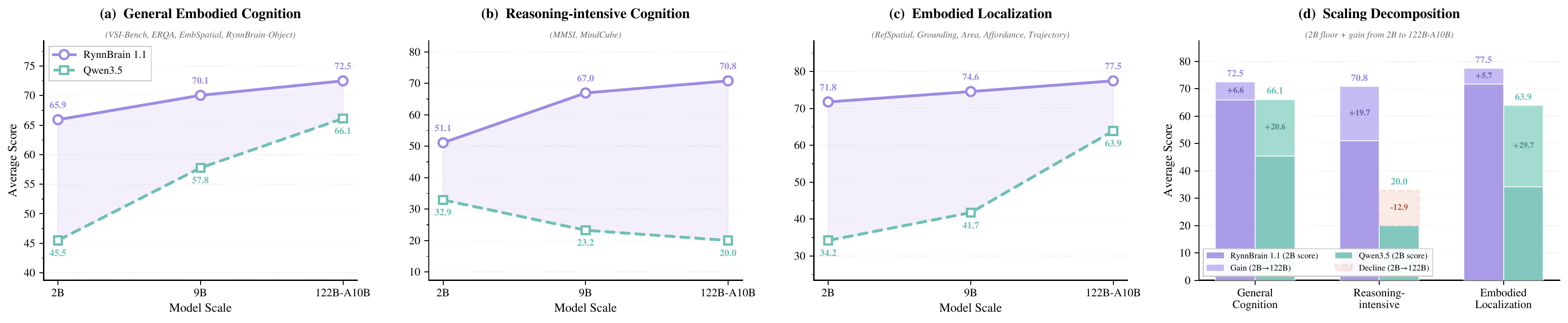
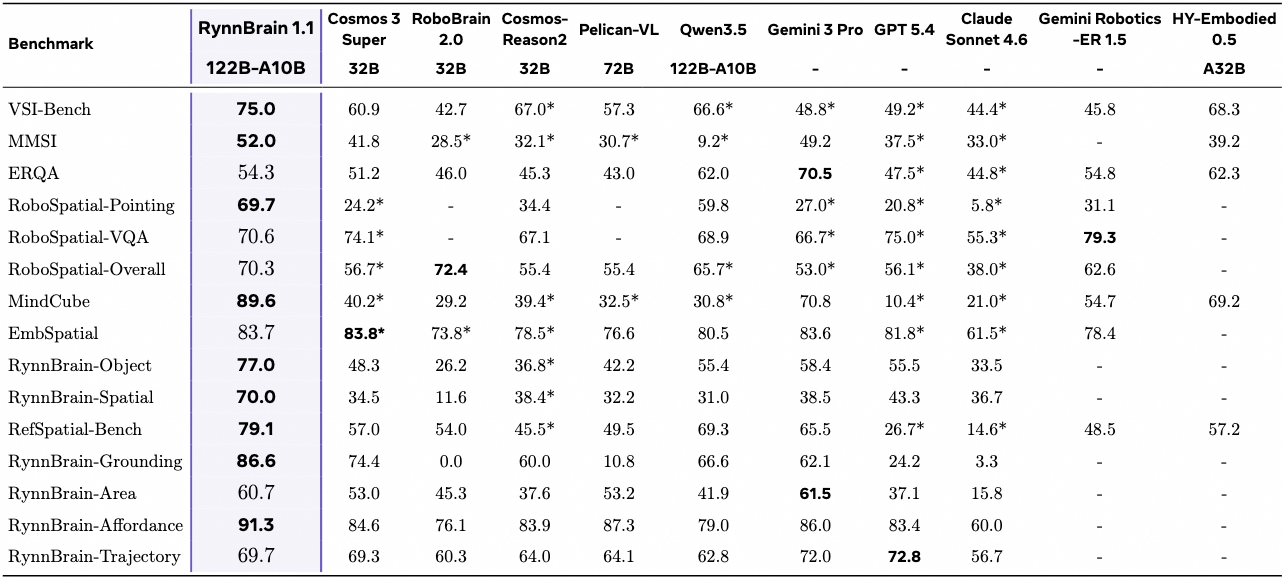
RynnBrain 1.1 is evaluated at 2B, 9B, and 122B-A10B scales under one unified embodied training recipe. Performance rises consistently across general cognition, reasoning-intensive cognition, and embodied localization.
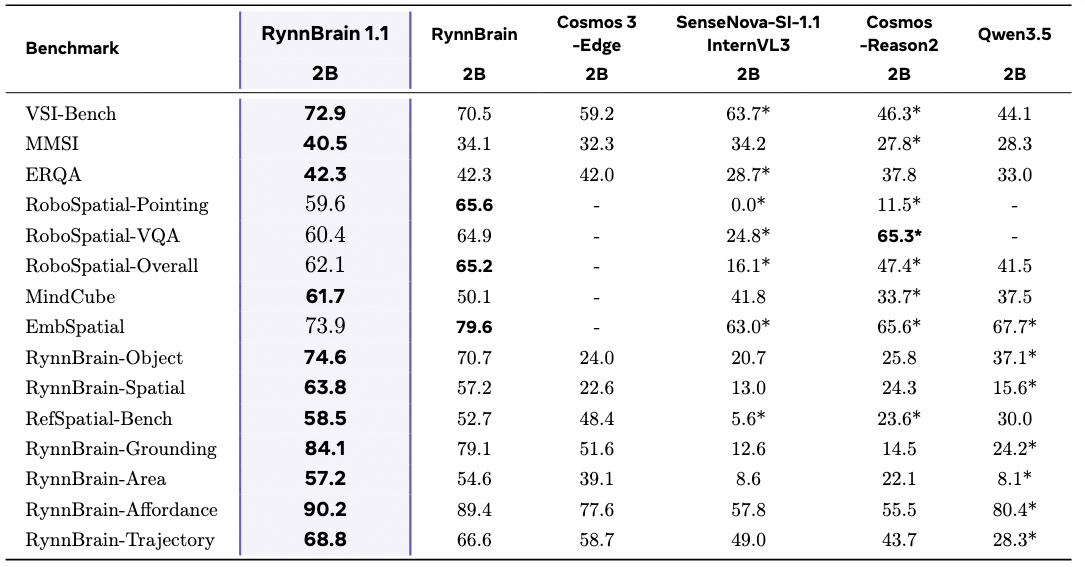
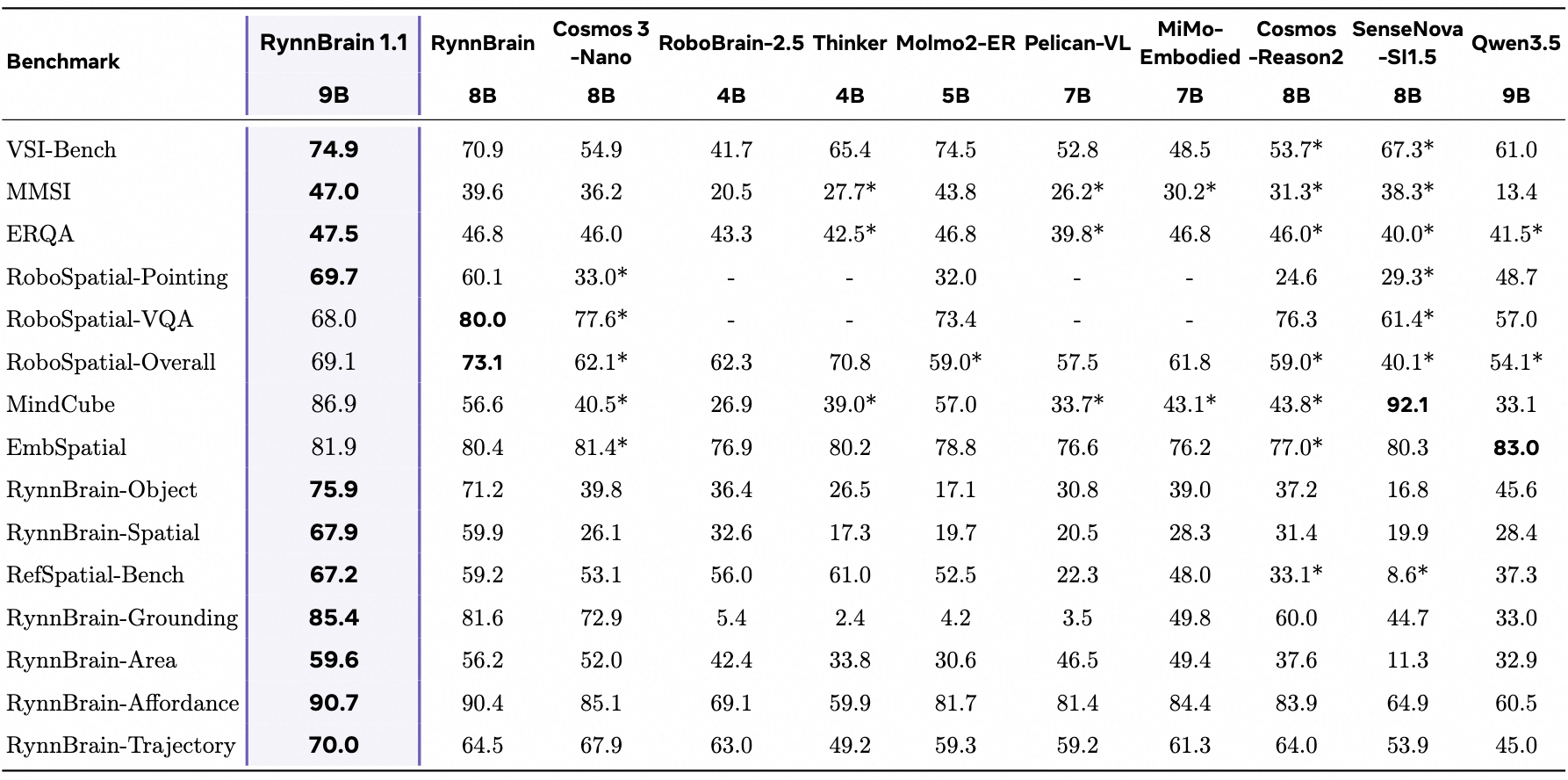
The four panels keep the scaling trend and all model-level comparisons together. Click any panel to inspect the full-resolution table.
Scaling Analysis
RynnBrain 1.1-2B
RynnBrain 1.1-9B
RynnBrain 1.1-122B-A10B
3D Grounding
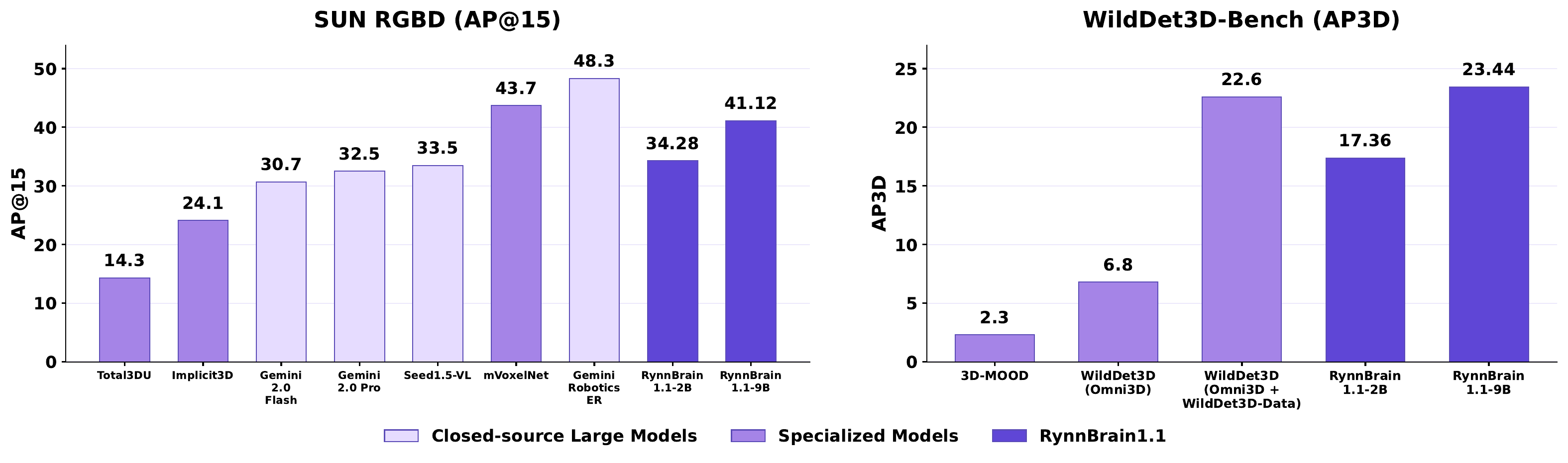
Explicit 3D supervision gives the compact models native language-conditioned 3D grounding. RynnBrain 1.1-9B reaches 41.12 AP@15 on SUN RGB-D and 23.44 AP3D on WildDet3D-Bench.
The gains from 2B to 9B show that metric depth, object size, orientation, and open-vocabulary spatial grounding all benefit from model scaling.
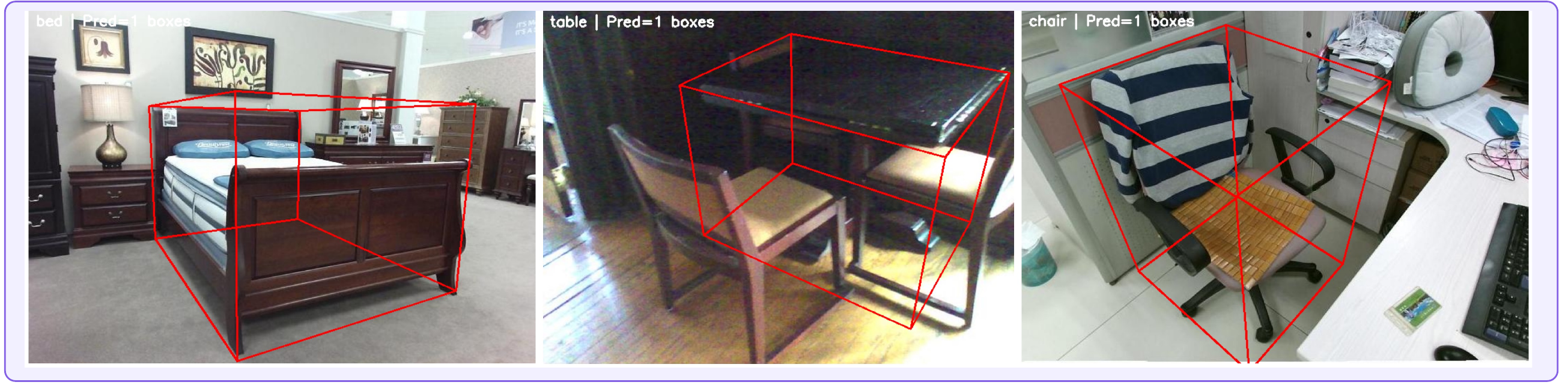
Results of RynnBrain 1.1-2B and 9B on SUN RGB-D and WildDet3D-Bench.Qualitative language-conditioned 3D box predictions across diverse indoor scenes.
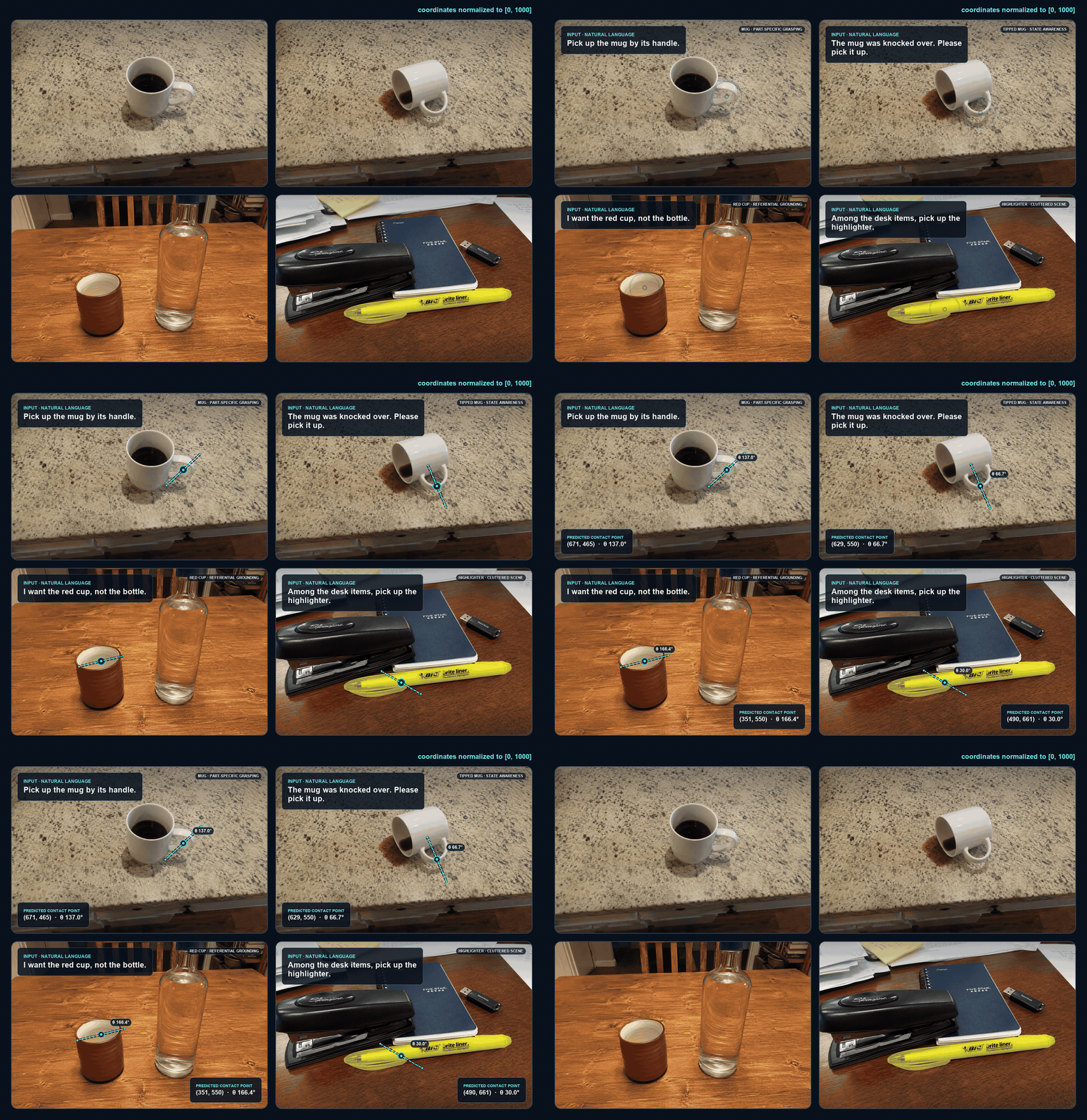
Contact Point Prediction
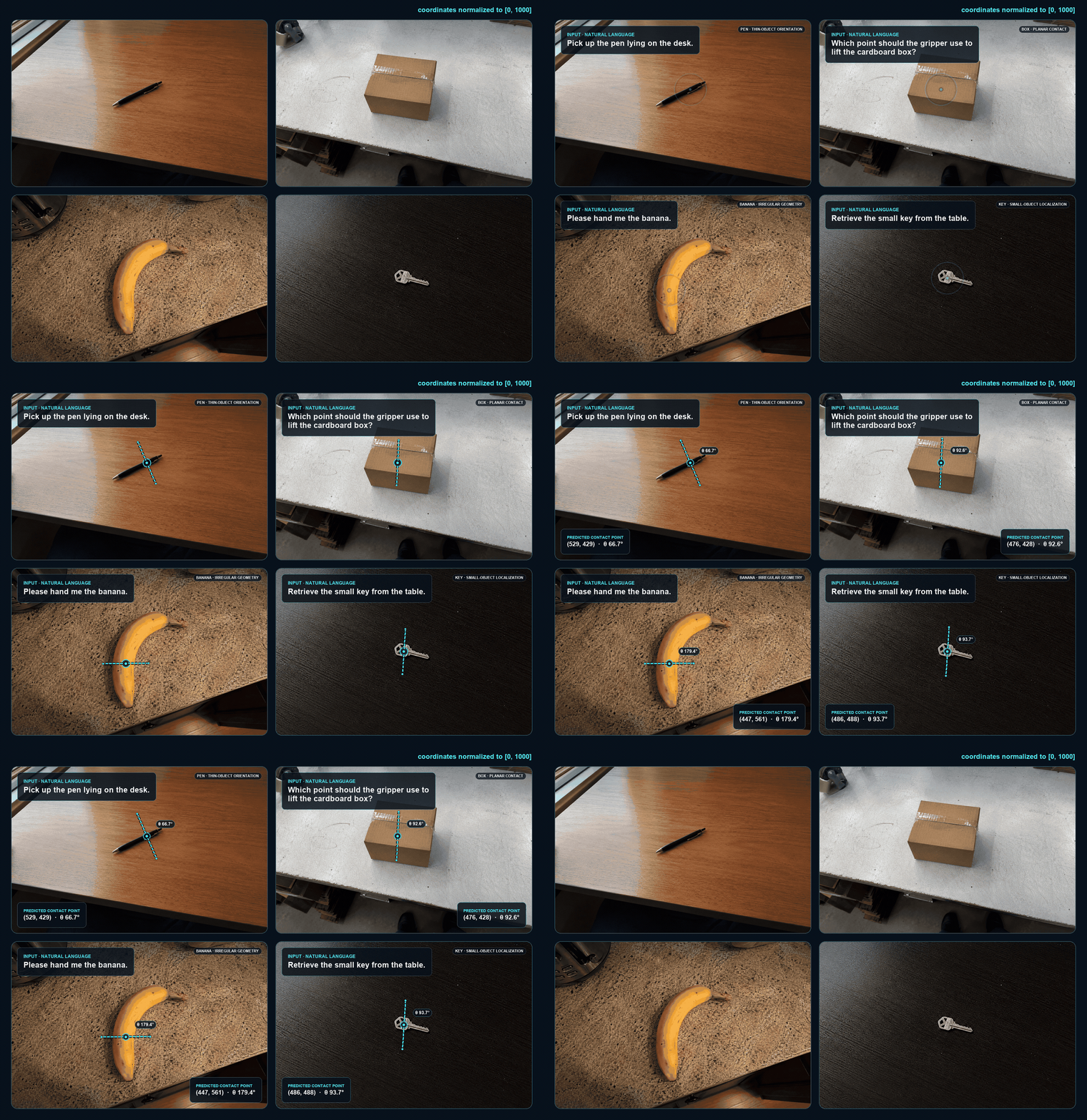
Instead of predicting only an object center, RynnBrain 1.1 identifies an action-relevant contact point together with its in-plane grasp orientation. The model adapts to object geometry, state, target part, and the user instruction.
These examples cover thin objects, containers, overturned objects, and cluttered scenes; both visual groups remain side by side for direct comparison.
Architecture
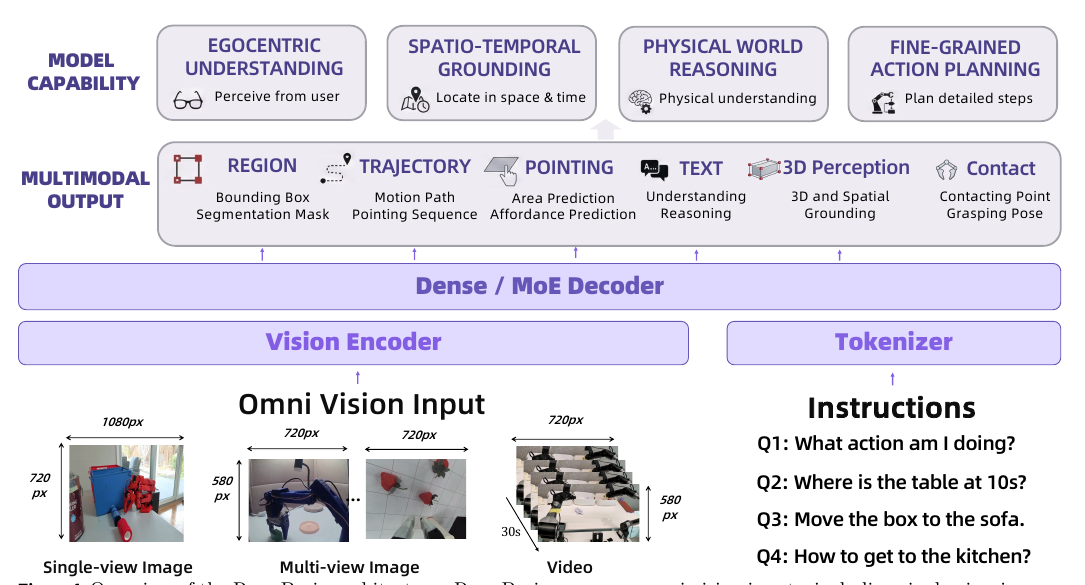
RynnBrain 1.1 connects omni-vision perception, language instructions, spatial grounding, physical-world reasoning, and action planning in a unified model family. The same high-level capability definition is shared by the 2B, 9B, and 122B-A10B variants.
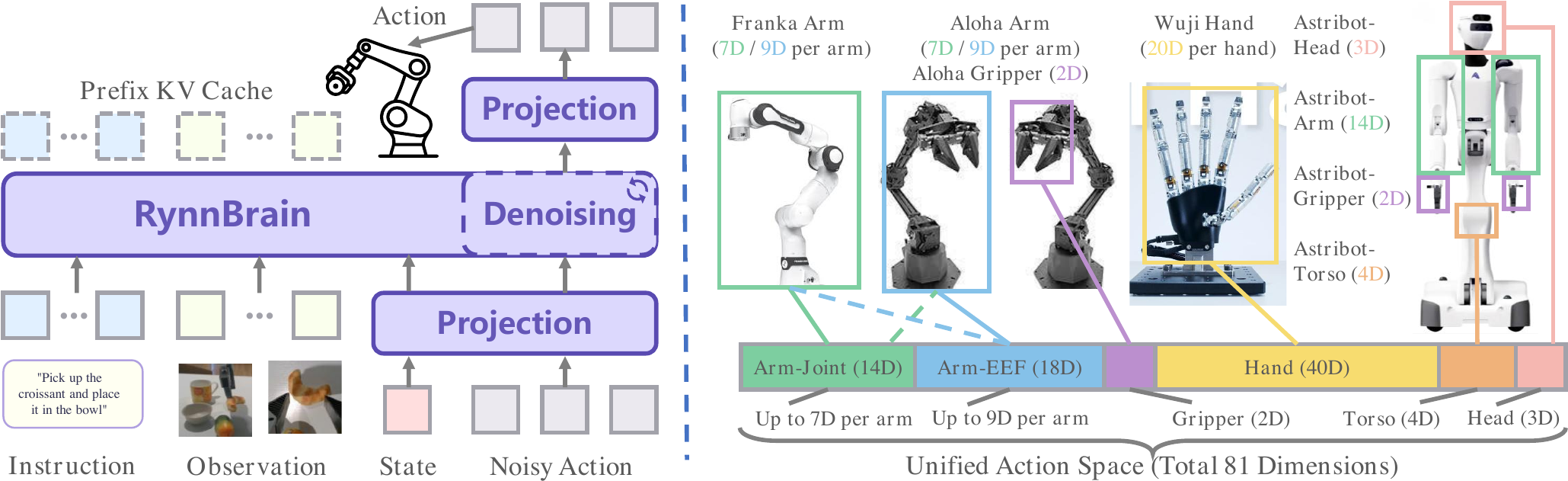
For physical execution, RynnBrain-VLA adds flow-matching action generation and a unified 81-dimensional action space that can be selectively activated for different robot embodiments.
Foundation model · Figure 1
Unified embodied perception and reasoning
A shared Dense/MoE decoder consumes single-view images, multi-view observations, videos, and instructions. It produces aligned text, regions, trajectories, pointing, 3D perception, and contact signals for four core capability groups.
Vision-language-action policy
One policy interface for heterogeneous robots
RynnBrain acts as the visual-language backbone while a denoising head predicts action chunks. Embodiment-specific masks activate compatible arm, gripper, hand, torso, and head dimensions without forcing incompatible controllers to share the same low-level action format.
Real-Robot Results
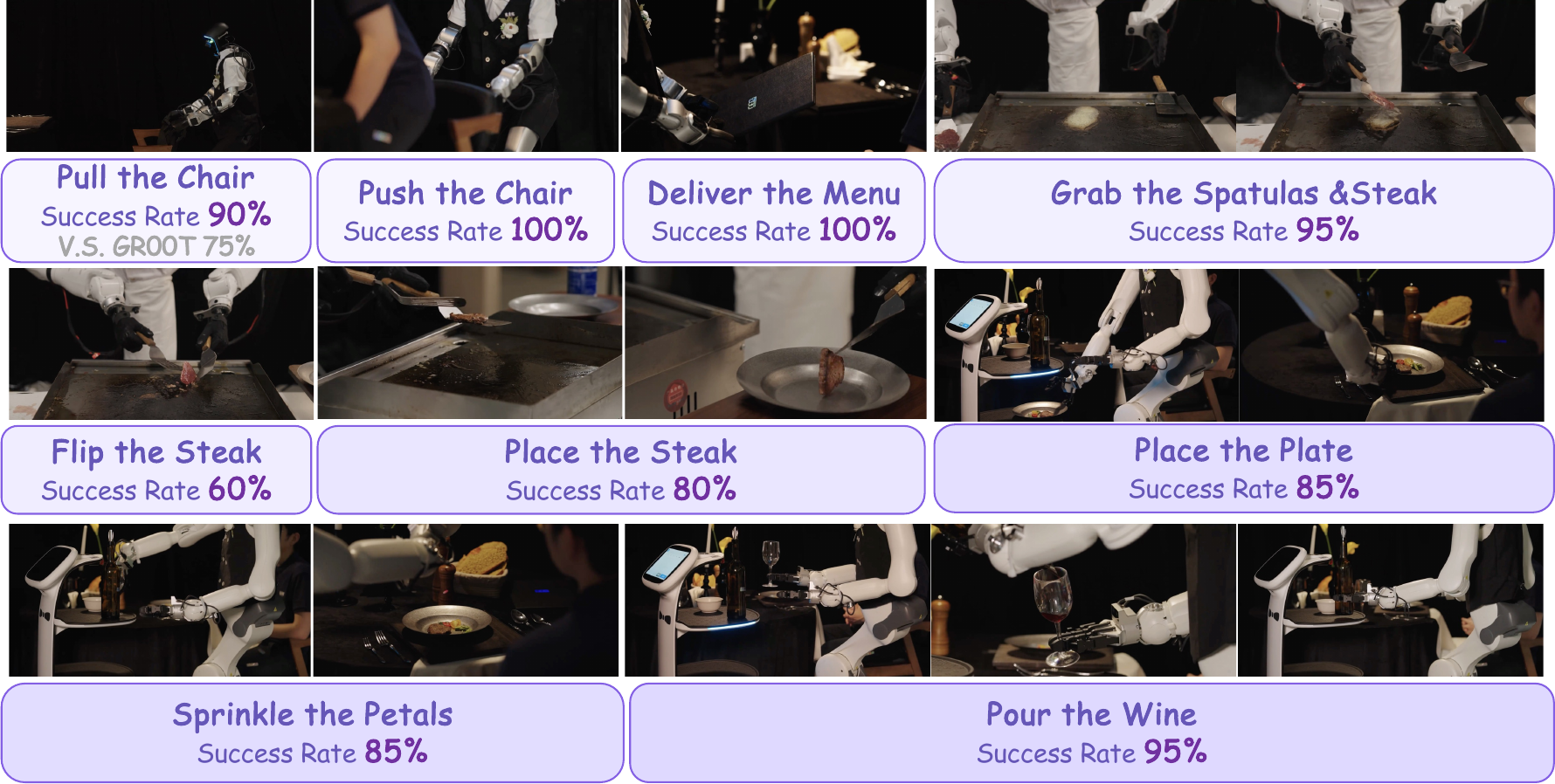
RynnBrain-VLA is deployed on Unitree G1, Astribot-S1, and Tianji-Wuji to test whole-body, bimanual, and dexterous manipulation in the physical world. The evaluation spans furniture interaction, food preparation, table service, and other long-horizon tasks.
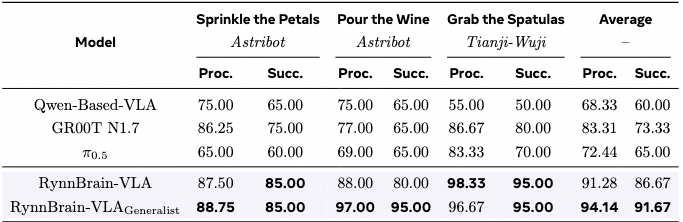
Each task is evaluated over 20 randomized trials with both process quality and final success recorded. Cross-embodiment metrics and the controlled comparison are summarized first, followed by a compact overview of all real-robot tasks.
Controlled comparison
Embodied pretraining strengthens the VLA policy
With the same demonstrations and post-training setup, RynnBrain-VLA reaches 91.28% process score and 86.67% success, compared with 68.33% and 60.00% for Qwen-Based-VLA. Joint multi-task and multi-embodiment training further improves the averages to 94.14% and 91.67%.
Nine real-world tasks across three heterogeneous robot platforms.
BibTeX
@article{rynnbrain2026,
  title   = {RynnBrain 1.1: Towards More Capable and Generalizable Embodied Foundation Model},
  author  = {Kehan Li and Bohan Hou and Minghao Zhu and Tianyi Zhang and Zesen Cheng and Zhikai Wang and Sicong Leng and Xin Li and Xiao Lin and Biying Yao and Minghua Zeng and Jiangpin Liu and Ronghao Dang and Jiayan Guo and Siteng Huang and Haoyu Zhao and Heng Ping and Yaxi Zhao and Kexiang Wang and Tong Lu and Shengke Xue and Jiahao Tang and Yulei Wang and Zejing Wang and Jianwei Gao and Shijian Lu and Chengju Liu and Jianfei Yang and Mingxiu Chen and Deli Zhao},
  year    = {2026},
  eprint  = {2607.17977},
  archivePrefix = {arXiv},
  primaryClass  = {cs.RO},
  url     = {https://arxiv.org/abs/2607.17977}
}