Project page
GeoProp: Grounding Robot State in Vision for Generalist Manipulation
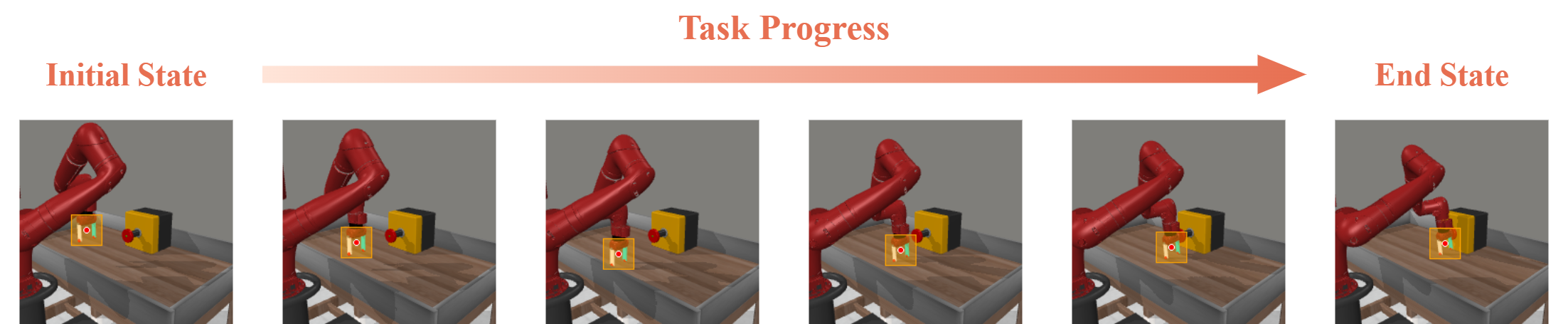
GeoProp turns proprioception from an isolated state vector into image-grounded visual tokens by projecting the end-effector into the policy's feature grid.
Abstract
Abstract
Proprioception is fundamental to robotic manipulation, yet standard fusion methods often treat it as an isolated vector lacking explicit alignment with visual tokens. Without a direct correspondence between 3D kinematics and 2D feature maps, manipulation policies struggle to ground the robot's state within the scene, frequently underperforming even vision-only baselines. To address this, we introduce GeoProp, a lightweight, plug-and-play adapter that aligns proprioception with vision through explicit geometric grounding and spatial feature sampling. GeoProp projects the robot state onto the image plane to sample localized visual features, constructing a grounded state token. It then injects state-derived spatial priors into the corresponding visual features via FiLM modulation. To capture motion intent, GeoProp further samples features at a short-horizon predicted coordinate derived from recent kinematics, providing look-ahead visual context. Across 67 tasks, GeoProp improves Diffusion Policy by 8.7% on 63 simulation tasks and π0 by 4.0% on the RoboTwin subset, and yields a 10.6% average gain across both policy families in the real world, while adding only 2-3% to the parameter count. These results demonstrate that GeoProp is a simple yet high-impact inductive bias for generalist embodied policies.
Method
A lightweight adapter for image-grounded proprioception.
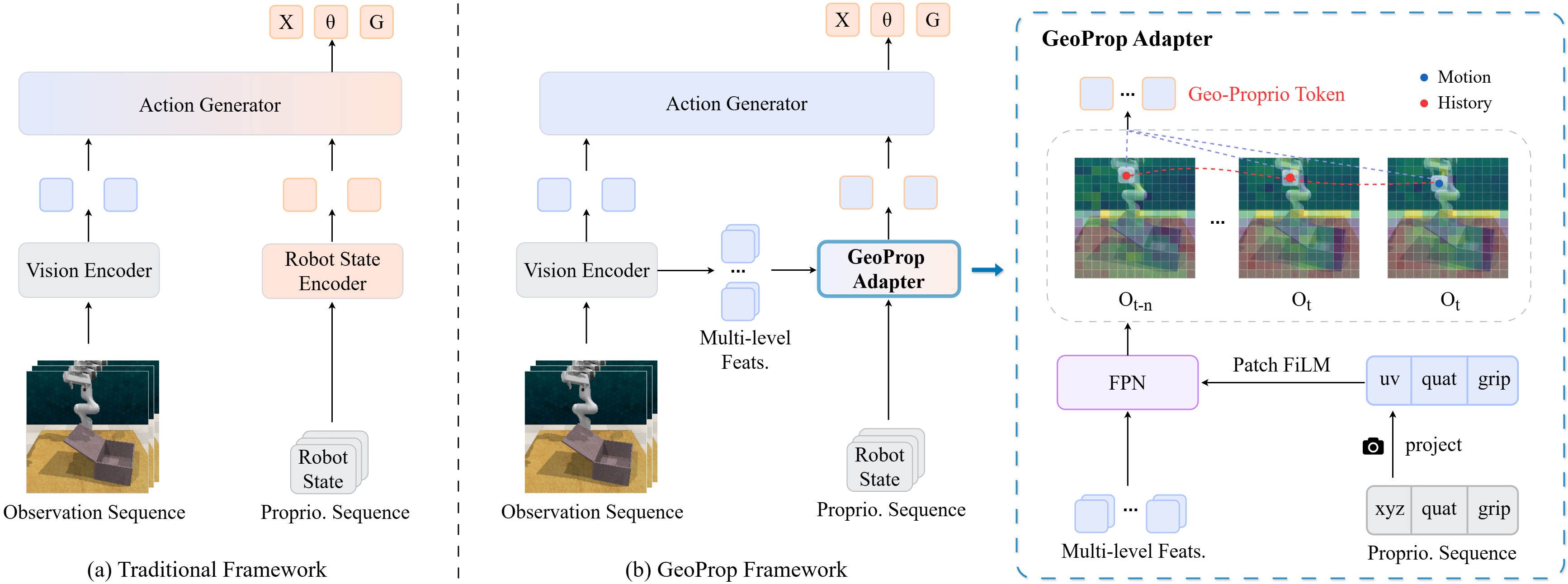
GeoProp is a lightweight, plug-and-play adapter that aligns proprioception with vision through explicit geometric grounding and spatial feature sampling. It keeps the downstream policy unchanged while converting robot state into image-native tokens sampled from the vision backbone.
Geometric projection and sampling
Camera calibration maps the 3D end-effector position to a 2D feature-grid coordinate. GeoProp samples the co-located visual feature to form the grounded state token.
Spatially aligned feature modulation
The proprioceptive state predicts FiLM parameters that modulate only the aligned feature cell, injecting pose, orientation, history, and gripper state without changing unrelated regions.
Predictive kinematic sampling
Recent end-effector history predicts a short-horizon waypoint. Sampling at its projected coordinate gives the policy a compact visual cue for near-future motion intent.
Results
Consistent gains across policies, backbones, and deployment settings.
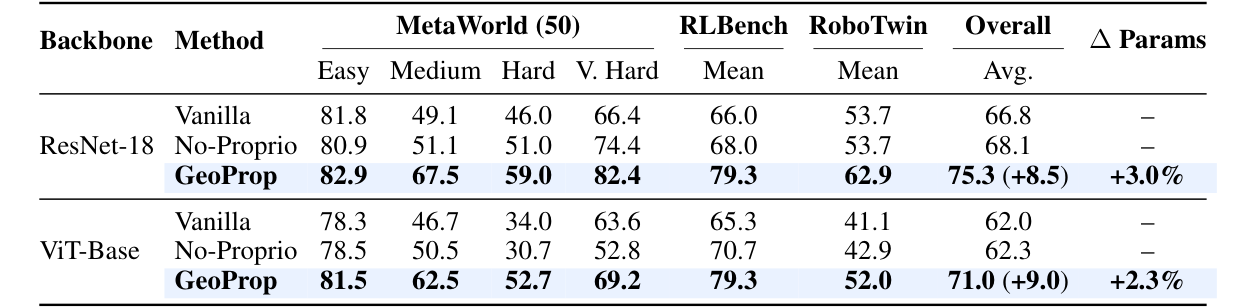
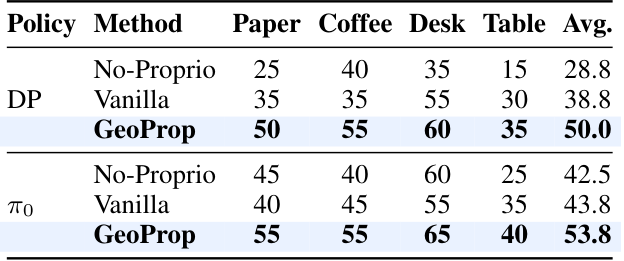
Across MetaWorld, RLBench, and RoboTwin, GeoProp improves over vanilla proprioception fusion, indicating that geometric state grounding is not tied to a single simulator or task family. We report Diffusion Policy results across 63 simulation tasks, results with the π0 policy on RoboTwin, and real-world Mobile ALOHA evaluation with both policy families.
Simulation benchmarks, 63 tasks
π0 on RoboTwin
Real-world success rates
GeoProp improves over vanilla proprioception fusion across simulation and real-world settings. The gains are obtained with only a small parameter overhead in the Diffusion Policy experiments, suggesting that the effect comes primarily from geometric alignment rather than model size.
Mobile ALOHA demonstrations across four household tasks
Videos show Diffusion Policy rollouts; the table above reports both Diffusion Policy and π0 real-world success rates.
Analysis
What GeoProp changes inside visual policy learning.
We analyze GeoProp from three complementary angles: whether projection remains reliable under calibration noise, whether grounded tokens improve state-vision alignment, and whether the sampled token carries richer local perception around the end-effector.
Projection is useful under moderate camera-robot drift.
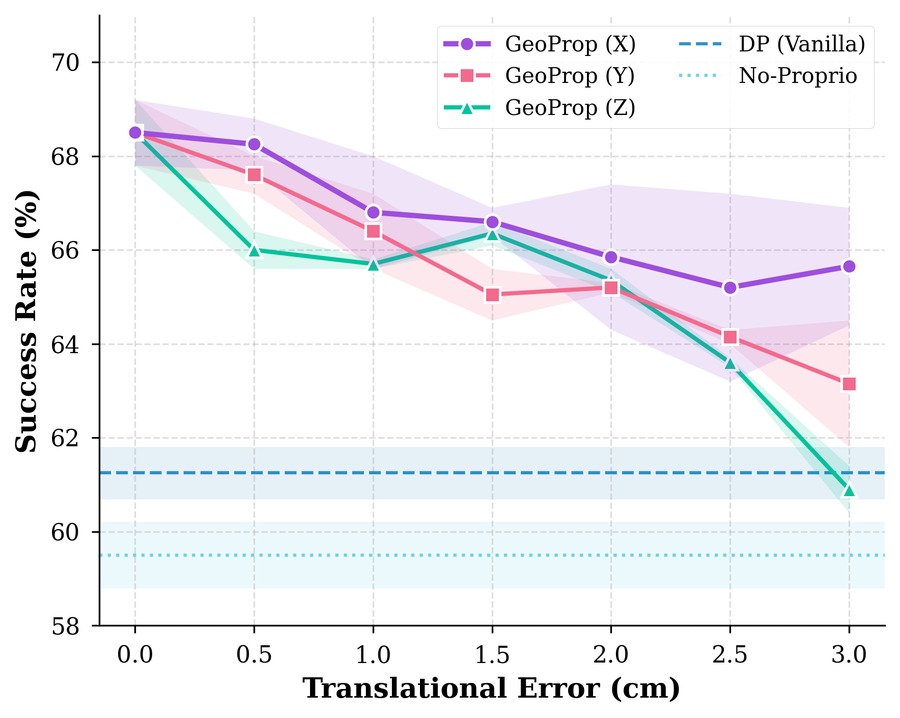
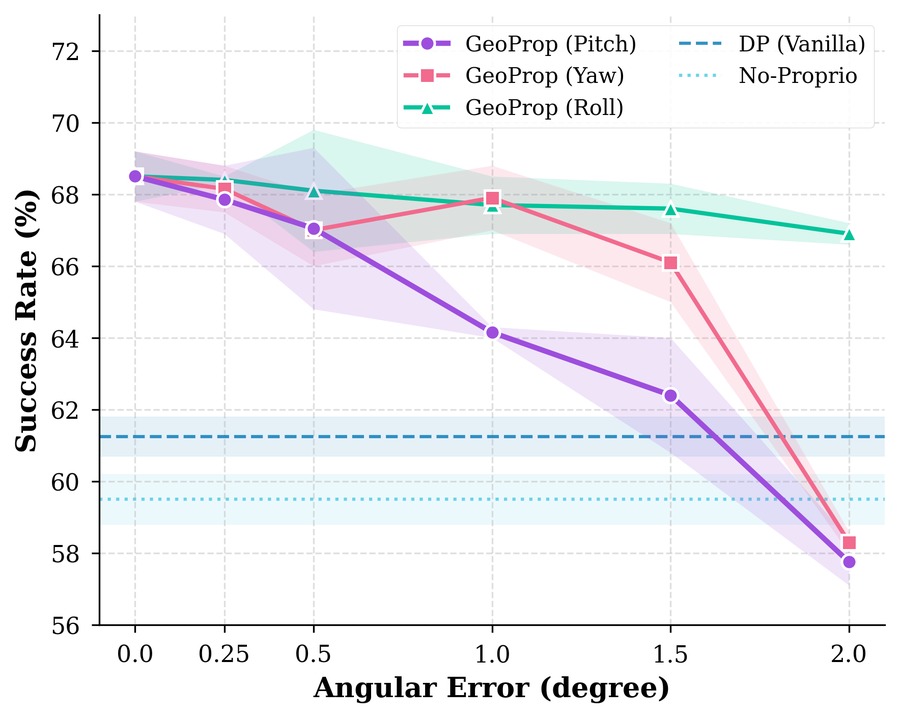
GeoProp relies on camera intrinsics and extrinsics to select the aligned feature cell, so we perturb camera extrinsics only at evaluation time. Performance degrades gradually as projection error grows, but remains above Vanilla and No-Proprio under mild-to-moderate drift, up to 2.5 cm translation error and 1.5 degrees rotation error in the reported setting.
Grounded state tokens make proprioception visible to the image stream.
Vanilla fusion injects proprioception as a global vector, so the policy must learn state-vision correspondence implicitly. GeoProp projects the end-effector into the feature grid and samples the co-located visual token, making proprioception image-native. The heatmaps show this effect directly: activations become more concentrated around the gripper and manipulated objects instead of spreading across background regions.
The state token carries nearby scene context, not only coordinates.
The projected end-effector cell is sampled from the vision backbone, so the resulting token contains local image semantics around the gripper. This lets the policy condition on information that is missing from raw proprioception alone, such as nearby objects, contact surfaces, and whether the end-effector is positioned around the task-relevant target.
Citation
BibTeX
@misc{zhao2026geopropgroundingrobotstate,
title = {GeoProp: Grounding Robot State in Vision for Generalist Manipulation},
author = {Guoyang Zhao and Quanhao Qian and Gongjie Zhang and Wenhao Li and Jiuniu Wang and Xiaowei Lu and Deli Zhao and Ran Xu},
year = {2026},
eprint = {2607.07101},
archivePrefix = {arXiv},
primaryClass = {cs.RO},
url = {https://arxiv.org/abs/2607.07101}
}